

Mongolia is Redefining Steppe Diplomacy with Kazakhstan
Guest Author
Mongolian President Khurelsukh Ukhnaa’s recent visit to
Kazakhstan forges a new model of Eurasian middle power resilience.
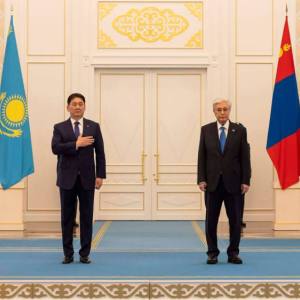
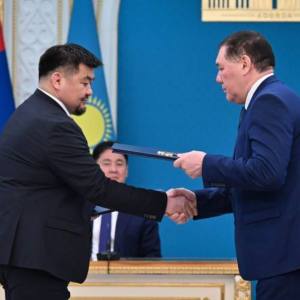
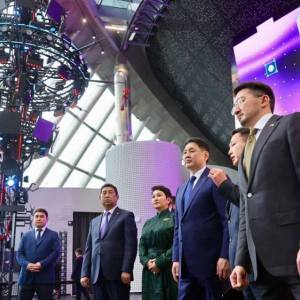
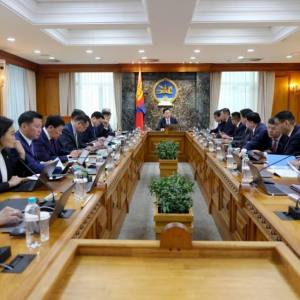
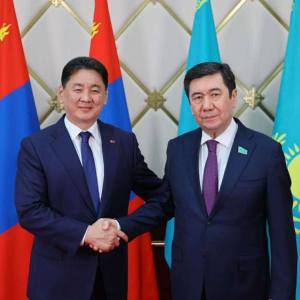
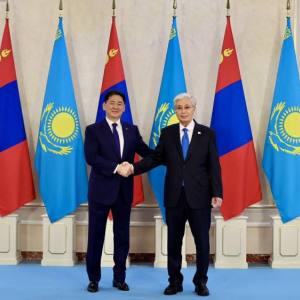
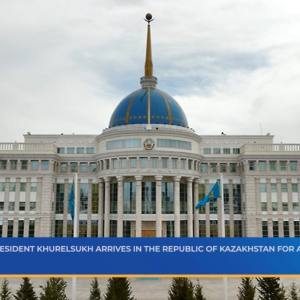
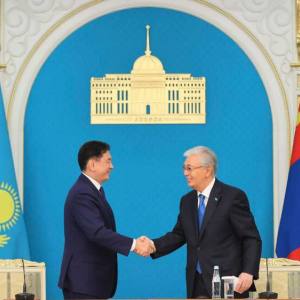
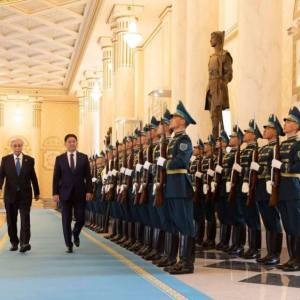
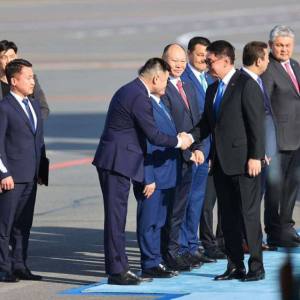
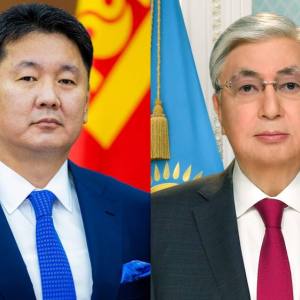
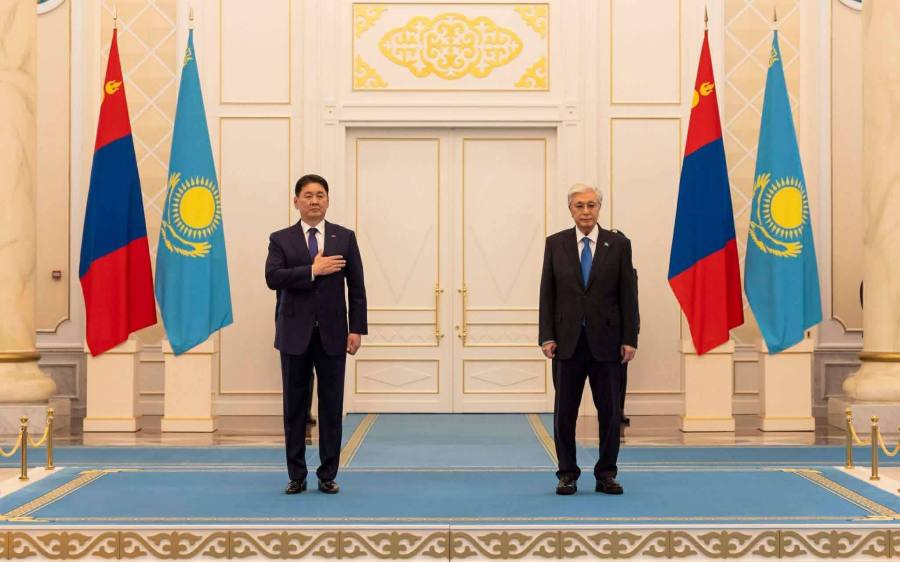
From April 20 to 23, Mongolian President Khurelsukh Ukhnaa completed the first state visit to Kazakhstan by a Mongolian head of state in two decades. Hosted by Kazakh President Kassym-Jomart Tokayev, Khurelsukh’s visit capped 18 months of accelerated engagement, starting with Tokayev’s 2024 trip to Ulaanbaatar. That 2024 summit was when the two nations elevated ties to a formal strategic partnership – making Kazakhstan Mongolia’s first and only strategic partner in Central Asia.
While
official rhetoric framed Khurelsukh’s visit as a celebration of “shared nomadic
heritage and millennial brotherhood,” its substance tells a pragmatic,
strategically urgent story: two landlocked, resource-rich states sandwiched
between Russia and China are using high-level engagement to reduce structural
economic dependence, exchange lessons in geopolitical resilience, and carve out
greater strategic autonomy amid intensifying great-power rivalry. Kazakhstan
and Mongolia are redefining middle-power cooperation in Eurasia’s polarized
landscape.
The Calculated Drivers of Reciprocal High-Level Engagement
The
flurry of bilateral exchanges since late 2024 reflects three overlapping,
strategically urgent priorities, amplified by shifting Eurasian geopolitics.
First,
Mongolia and Kazakhstan aim to translate 34 years of diplomatic goodwill into
tangible economic results, addressing a shared vulnerability: overreliance on
their two giant neighbors for trade and transit. Official data from
Kazakhstan’s Ministry of National
Economy shows bilateral trade with Mongolia reached $133 million in 2025, up 7.7 percent year-on-year – but still a fraction of the two nations’ combined economic capacity. During the recent state visit, both sides reaffirmed an ambitious target to lift bilateral turnover to $500 million, anchored by a temporary free trade agreement ratified in 2025 between Mongolia and the Eurasian Economic Union (EAEU), which offers tariff preferences for 367 Mongolian export lines (97.5 percent agricultural and livestock goods), and the 2025–2027 Trade and Economic Cooperation Roadmap.
During
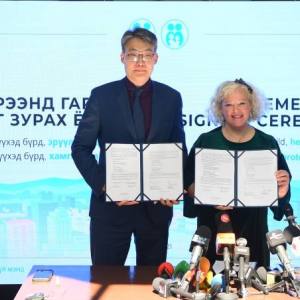
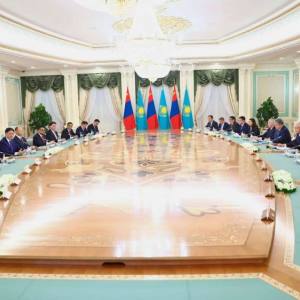
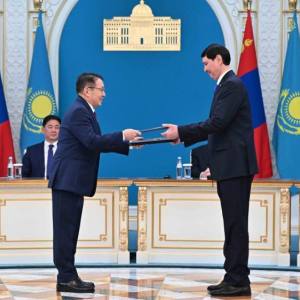
Khurelsukh’s Kazakhstan visit, delegations exchanged 13 intergovernmental
agreements spanning foreign policy, trade, energy, nuclear energy, central
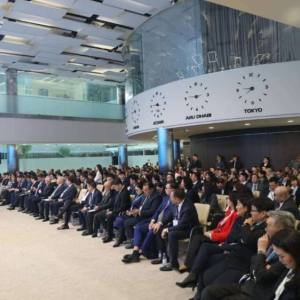
banking, finance, and media collaboration, while the concurrent Kazakhstan-Mongolia Business Forum drew
250 representatives, yielding 19 binding commercial deals worth over $20
million. Landmark agreements include a memorandum between Kazakhstan’s Samruk-Kazyna
sovereign wealth fund and Mongolia’s Erdenes
Mongol state mining holding on critical mineral exploration and value-added
processing; a long-term deal for Kazakhstan to meet 100 percent of
Mongolia’s wheat
import demand; and a commitment for stable Kazakh gasoline and diesel
supplies to Mongolia.
Kazakhstan’s
advances in agricultural processing, food security, and livestock biosecurity
directly address Mongolia’s chronic inability to add value to its
70-million-head livestock herd – the world’s largest per capita. During a joint
press briefing, Tokayev formalized plans to establish joint
vaccine production facilities in Mongolia and deepen
collaboration on modern agrotechnology, alongside aligning livestock product
standards with international safety norms. The two sides also advanced two-way
processing ties. Building on a wool
and leather agreement, Mongolian investors are
targeting Kazakh livestock sectors, leveraging Mongolia’s established expertise
in these industries.
For
Kazakhstan, the partnership opens a low-risk gateway to Northeast Asia; for
Mongolia, it offers a rare pathway to reduce extreme dependence on China, which
absorbs over 90 percent of its exports, and Russia, which supplies 90 percent
of its refined energy. And the benefits extend beyond Kazakhstan itself:
Khurelsukh also met Armenian
President Vahagn Khachaturyan, who was visiting Kazakhstan to
attend the Regional
Ecological Summit 2026 (RES 2026), to discuss
expanding Mongolian agricultural exports to the South Caucasus via the
Mongolia-EAEU agreement.
Second,
the bilateral exchanges advance both nations’ signature foreign policy
doctrines: Mongolia’s “Third Neighbor” policy and Kazakhstan’s multi-vector
diplomacy. For Mongolia, deepening ties with Kazakhstan operationalizes the
Third Neighbor framework in its western neighborhood, framing a fellow Eurasian
steppe nation as a reliable partner beyond its two giant neighbors. Mongolia is
also increasing its engagement with
the Organization
of Turkic States (OTS), in which Kazakhstan is a
founding member. For Kazakhstan, which recalibrated its foreign policy to
reduce overreliance on Russia in the wake of the January 2022 unrest and then
Russia’s February 2022 full-scale invasion of Ukraine, engagement with Mongolia
burnishes its credentials as a neutral regional bridge-builder between Central
and Northeast Asia.
Neither
country seeks to align against Russia or China; instead, the partnership offers
a way to diversify options without crossing geopolitical red lines. As Zolboo Dashnyam,
director of the Institute of International Studies at the Mongolian Academy of
Sciences, noted,
both Kazakhstan and Mongolia are working to “pursue pragmatic cooperation
without provoking the sensitivities of their larger neighbors.”
Finally,
these visits serve domestic political legitimacy and legacy-building goals for
both presidents. For Khurelsukh, the trip marks the completion of his historic
campaign to conduct state visits to all five Central Asian republics during his
tenure, cementing his legacy as the architect of Mongolia’s westward strategic
pivot ahead of the 2027 presidential election. It also reinforces his
domestic “Ethics
Revolution” agenda, framing his foreign policy as a
tool to deliver economic opportunity and reduce corruption-driven
dependence on extractive exports to China.
For
Tokayev, the recent state visits comes just weeks after a national referendum
that adopted a sweeping new constitution, the centerpiece of his “New
Kazakhstan” reform agenda. Hosting Khurelsukh reinforces
his narrative of a Kazakhstan that is open, influential, and committed to
inclusive regional leadership, while providing a high-profile diplomatic win to
consolidate domestic support for his reform agenda.
Two-Way Learning
The most understudied, consequential dimension of the deepening Kazakhstan-Mongolia relationship is the structured exchange of governance and development lessons, rooted in complementary strengths and shared vulnerabilities. Both nations rank among the world’s leaders in per capita land availability, while facing identical threats from climate change, desertification, and great-power economic coercion.
For Ulaanbaatar, Kazakhstan offers field-tested models to address its structural weaknesses.
Kazakhstan’s
decades-long experience building a foreign direct investment (FDI) ecosystem,
which has attracted $151.3 billion in inward FDI stock – nearly 70 percent of
total FDI in Central Asia – holds lessons for Mongolia. Kazakhstan’s success
rests on a unified legal framework, a centralized “one-stop shop” for
investors, and 17 Special Economic Zones with targeted incentives, offering a
replicable blueprint for Mongolia to attract diversified capital beyond its
mining sector.
Furthermore,
Kazakhstan’s expertise in turning geographic isolation into an asset via the
Trans-Caspian International Transport Route (the Middle Corridor) provides a
blueprint for Mongolia’s transit ambitions. As a fellow landlocked state,
Kazakhstan has leveraged its position between Europe and Asia to become a
critical transit hub, exactly what Mongolia hopes to achieve by linking to
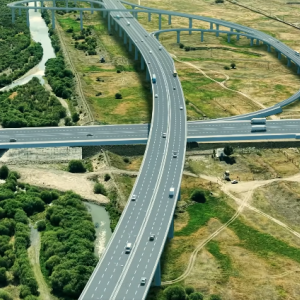
Central Asia via Kazakhstan. During the summit, the two sides agreed to form a
joint working group to advance a cross-border highway, resume direct
Astana-Ulaanbaatar air service, and launch a new Oskemen-Bayan-Ölgii route,
addressing the greatest barrier to bilateral trade: the lack of a shared
border, which forces all overland goods to transit Russian territory.
In
addition, Kazakhstan’s advances in digital governance and aerospace innovation
align with Mongolia’s modernization ambitions. With 2026 designated
Kazakhstan’s Year of Artificial Intelligence, the country has built a mature
tech ecosystem anchored by the Astana Hub technopark, and previously exported
its first domestically engineered Earth remote sensing satellite to Mongolia in
2024. Kazakh officials have also shared lessons from its eGov system, which
provides online access to more than 90 percent of government services, a model
Mongolia is eager to adapt for its e-Mongolia platform, which already covers 85
percent of the adult population.
For
Astana, Mongolia provides equally valuable lessons aligned with its reform
agenda.
Mongolia’s
30 years of implementing the Third Neighbor policy offers a proven playbook for
balancing relations with Russia and China while cultivating diversified global
partnerships. Kazakhstan’s post-2022 multi-vector diplomacy mirrors Mongolia’s
long-standing approach: maintaining pragmatic ties with its giant neighbors
while avoiding over-dependence, and using neutral status to attract investment
and influence. As Mendee Jargalsaikhan, director of the Institute for Strategic
Studies of Mongolia, emphasized,
Mongolia’s constitutionally enshrined neutrality has allowed it to navigate
repeated great-power shocks without sacrificing sovereignty – a lesson
Kazakhstan has embraced amid post-Ukraine war geopolitics.
Meanwhile,
Mongolia’s global leadership on sustainable rangeland management and dryland
restoration offers a blueprint for Kazakhstan’s climate goals. As the driving
force behind the United Nations’ designation of 2026 as the International Year
of Rangelands and Pastoralists, and host of the 2026 UNCCD COP17
desertification summit in August, Mongolia has developed globally recognized
expertise in community-based pastoral management. During Khurelsukh’s visit,
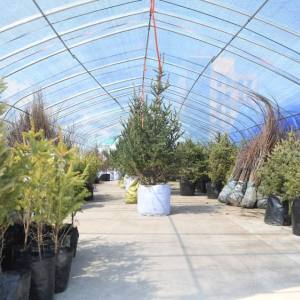
the two nations agreed to synchronize Mongolia’s “Billion Trees” campaign with
Kazakhstan’s “Two
Billion Trees” initiative – a partnership now formally
included in the RES
2026 regional project portfolio as a flagship
cross-Altai ecological program.
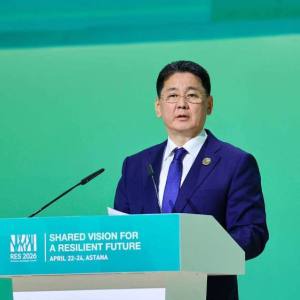
At
RES 2026, which convened 1,500 delegates from more than 15 countries from April
22-24, Khurelsukh unveiled three core Mongolian initiatives for regional
cooperation: integrated water resource management, sustainable pasture
governance, and nature-based solutions. He also formally invited all
participating nations to attend UNCCD
COP17 in Ulaanbaatar, positioning Mongolia as a global
leader in dryland restoration.
Mongolia’s
inclusive governance of its 120,000-strong ethnic Kazakh minority in
Bayan-Ölgii aimag offers a model for cross-border ethnic cohesion, with Tokayev
explicitly thanking Mongolia for its support in opening
a Kazakh consulate in the province.
Finally,
Mongolia’s track record of democratic consolidation – the country is rated
“free” with a score of 84 out of 100 in Freedom
House’s 2026 report, compared to Kazakhstan’s 23
score and “not free” rating – offers a low-pressure reference point for
Kazakhstan.
Strategic Significance and Inescapable Structural Limits
The
summit’s significance extends far beyond bilateral ties. Regionally, the
partnership creates a critical bridge between Central and Northeast Asia, with
Tokayev’s proposed “Trans-Altai
Dialogue” platform seeking to scale this model into a regional
cooperation framework for the four Altai Mountain nations. The two presidents
also discussed Mongolia’s potential inclusion in future C5+1 dialogues,
formalizing its place in a regional architectures from which it has
historically been excluded.
There
are, however, significant structural constraints to the expanding partnership.
The most intractable barrier is geography. The lack of a shared border means
every shipment must transit Russian or Chinese territory, exposing bilateral
trade to external vetos and cost inflation. While the planned
highway promises to reduce transit times by 800 kilometers
and cut logistics costs by 20 percent, it requires tripartite negotiations with
Russia, with no clear timeline for completion.
Second,
bilateral trade remains deeply imbalanced, with Kazakh exports accounting for
over 90 percent of total turnover in 2025. Mongolia’s exports are dominated by
low-value, unprocessed livestock products, while Kazakhstan sends value-added
processed food, machinery, and industrial goods. This dynamic risks entrenching
dependency rather than balanced interdependence. Reaching the $500 million
trade target will require transformative investment in Mongolia’s processing
capacity.
Third,
domestic political uncertainty could disrupt long-term continuity. In Mongolia,
Khurelsukh is bound by 2019
constitutional amendments to a single non-renewable
six-year term. With the 2027 presidential election already shaping up to be a
divisive contest, his westward pivot could be deprioritized under a new
administration. In Kazakhstan, while Tokayev’s position appears stable, the
implementation of his
new constitutional framework is in its early stages, with
bureaucratic resistance potentially slowing cooperation.
Finally,
the partnership faces invisible geopolitical red lines. Any meaningful
expansion requires the tacit approval of Russia and China, and neither nation
can afford to alienate its giant neighbors. The partnership’s greatest strength
– its non-aligned, neutral character – is also its greatest limitation,
restricting cooperation to areas that do not challenge the regional status quo.
Conclusion
Khurelsukh’s historic state visit to Kazakhstan is more than a celebration of shared nomadic heritage. It marks the coming of age of a pragmatic partnership between two middle powers seeking to turn geographic vulnerability into strategic advantage amid great-power rivalry. The summit’s agreements, commercial deals, trade targets, and connectivity plans demonstrate that Kazakhstan and Mongolia have moved beyond symbolic rhetoric to tangible, results-driven cooperation. The two-way exchange of development lessons further cements the partnership as a rare model of peer-to-peer learning between Eurasian middle powers.
Yet
the ultimate success of the partnership will not be measured by the number of
documents signed, but by its ability to overcome structural barriers of
geography, trade imbalance, and geopolitical constraints. For Mongolia, the
test will be whether deeper ties with Kazakhstan deliver meaningful
diversification away from its dependence on China and Russia, while
strengthening its geopolitical resilience. For Kazakhstan, the test will be
whether the partnership enhances its influence as a Eurasian bridge-builder,
while advancing its domestic reform agenda.
In
an era when great-power competition often crowds out regional initiative, the
Astana-Ulaanbaatar axis offers a hopeful counternarrative.